
L-IN EYE · 2022–2024

Human-state monitoring system

L-IN EYE

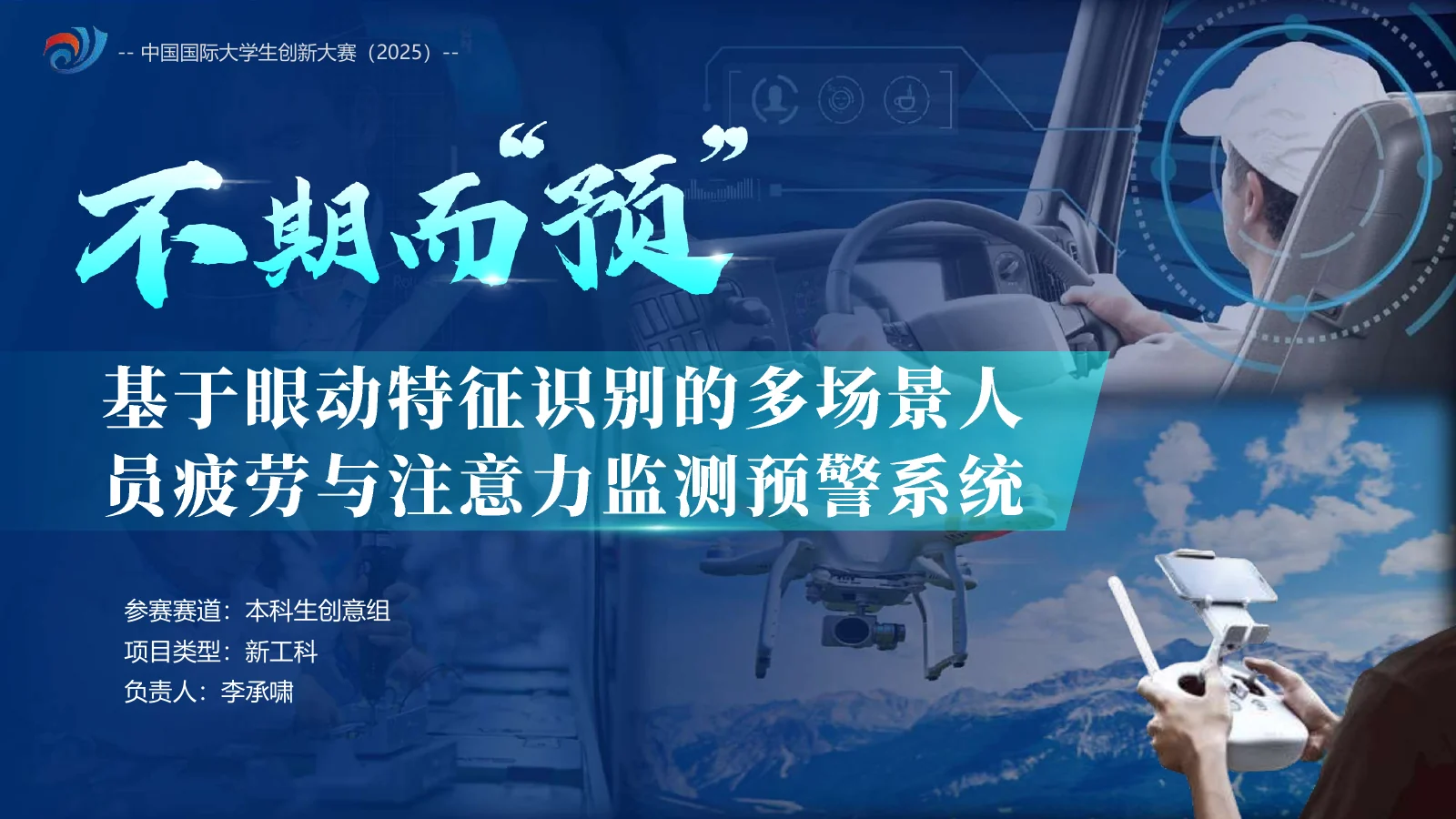
A research prototype for fatigue and attention monitoring through ocular, facial and operating-state signals.

L-IN EYE
01 / overview

Observe the operator as part of the system.

Project Direction

L-IN EYE develops a multi-scenario fatigue and attention monitoring workflow around ocular features, facial motion and operating-state information. The system connects sensing hardware, feature extraction, state assessment, user interface and alert output.

02 / scenarios

One human-state layer, multiple operating contexts.

Multi-Scenario Monitoring

01

UAV operation

Operator attention and fatigue during long-duration remote missions.

02

Aviation

Human-state awareness for high-workload cockpit and support roles.

03

Road driving

Fatigue and attention monitoring within the intelligent-mobility safety stack.

04

Industrial operation

Continuous observation for production and equipment-control environments.

03 / architecture

A complete human-state monitoring loop.

Sensing to Intervention

04 / model

Eye movement, facial motion and operating context.

Feature Recognition

The research route combines facial and ocular landmark localisation with eye-motion features and incremental model updates. The aim is a lightweight recognition workflow suited to real-time operator monitoring.

LANDMARKS

Face and eye localisation

Key regions are located before detailed ocular features are extracted.

FEATURES

Ocular behaviour

Fixation, blink and eye-motion patterns form the basis of state assessment.

LEARNING

Incremental adaptation

Model updates support continued adaptation across users and scenarios.

PRIVACY

Feature-level processing

The system direction emphasises compact feature processing for operator-state analysis.

05 / optics

Designed for difficult lighting conditions.

Imaging Hardware

The hardware concept includes monocular infrared and dual-depth variants. A coated optical element and 940 nm narrow-band filter are used to manage glare and improve imaging consistency under strong backlight.

06 / journey

From system definition to internal testing.

2023–2024

2023.11

Team & scope

Initial project structure and application scope.

2023.12

System design

Overall sensing and control architecture.

2024.04

Prototype development

Central control and data workflow.

2024.08

Software integration

Monitoring interface and recognition workflow.

2024.11

Internal testing

System-level operation and application trials.